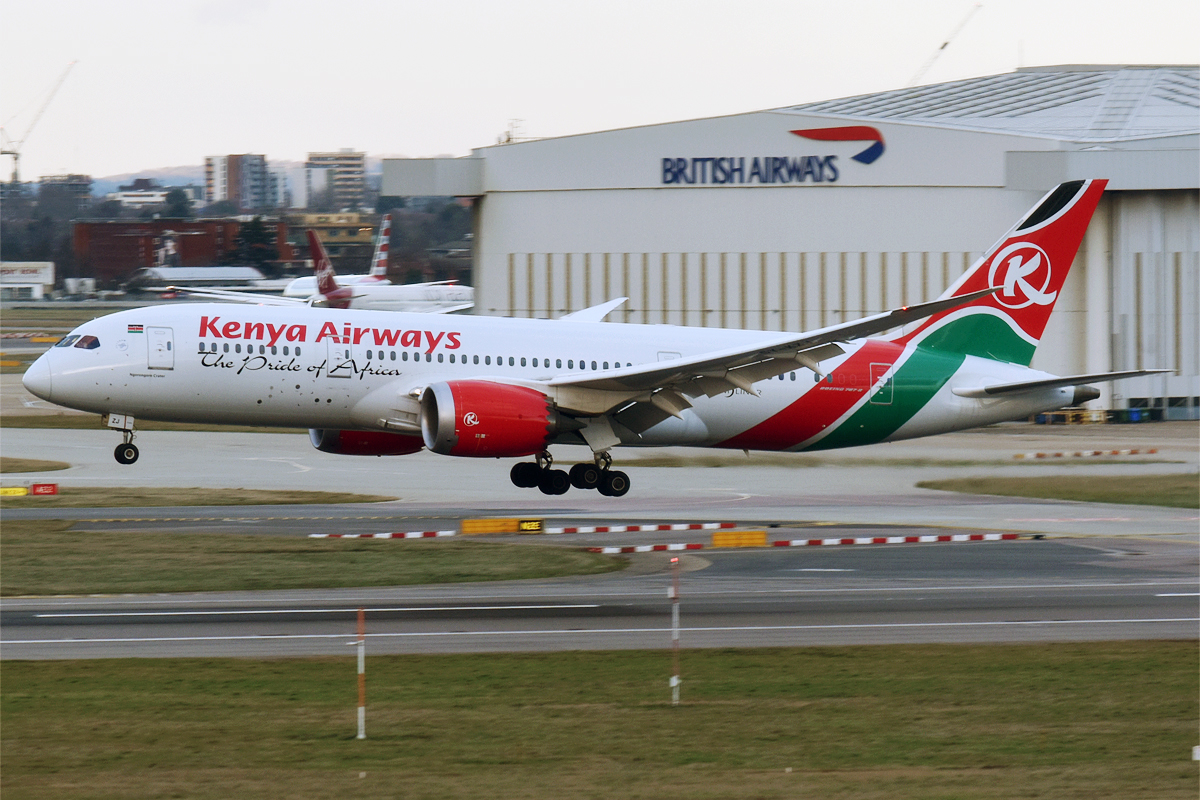
Kenya Airways has issued a profit warning for 2026, saying its full-year earnings will be at least 25 per cent lower than in 2025. The Kenya Airways profit warning, dated 26 November and signed by chairman Kiprono Kittony, blames a surge in jet fuel prices linked to the war in the Middle East and a shortage of spare parts that has kept aircraft on the ground, The Standard reported.
What the Kenya Airways profit warning says
The notice was issued under Kenya’s Capital Markets Act regulations. Listed companies in Kenya must warn investors when they expect earnings to fall by 25 per cent or more compared with the previous year.
In the statement, the board said it expects earnings for the year ending 31 December 2026 to be at least 25 per cent lower than those for 2025. It pointed to what it called extraordinary industry conditions. The board said these factors had put sustained pressure on margins and on the profitability of the airline’s network.
The warning was also reported by Citizen Digital and HapaKenya. The airline, known by its code KQ, is listed on the Nairobi Securities Exchange.
Why profit warnings matter
A profit warning is designed to protect investors. It gives shareholders early notice that results will be much weaker than before, so they are not caught by surprise when the annual report arrives. It also helps keep trading in the company’s shares fair.
For Kenya Airways, the warning comes about a month before the end of its financial year on 31 December. That suggests the board does not expect conditions to improve enough in December to change the picture. Investors will now look closely at the airline’s next steps to protect cash.
A difficult comparison
The 2025 baseline was already weak. HapaKenya noted that Kenya Airways posted a net loss of Ksh17.2 billion in 2025, reversing a profit of Ksh5.4 billion in 2024. That 2024 profit had been the airline’s first in more than a decade.
Because 2025 ended in a loss, the warning effectively signals that the 2026 result will be worse. The exact scale will only be clear when the airline publishes its full-year results next year.
Fuel costs bite
Fuel is the biggest single problem. According to The Standard, jet fuel made up about 32 per cent of Kenya Airways’ operating expenses in the first half of 2026. It accounted for 52 per cent of direct operating costs, and fuel spending rose by 32 per cent.
Jet fuel prices have climbed sharply this year because of the conflict involving Iran. Airlines around the world have struggled to pass these costs on to passengers through higher fares. Carriers that buy fuel at spot prices, without long-term hedges, have been hit hardest.
For an airline based in East Africa, the conflict has added further pressure. Many of Kenya Airways’ routes connect Nairobi with the Middle East, Asia and Europe. Airspace closures and diversions in the region can mean longer flights and more fuel burned.
Grounded aircraft and the spare parts shortage
The second problem is a shortage of spare parts. Supply chain problems across the aviation industry have left many airlines waiting months for engines and components. Kenya Airways says the shortage has forced it to ground aircraft and fly less.
The global engine crisis has affected carriers of all sizes. Engine makers are struggling to keep up with demand for maintenance and spare engines. As a result, aircraft that are otherwise airworthy sit idle while they wait for parts.
For Kenya Airways, fewer aircraft meant fewer flights. In the first half of the year, its capacity fell by 9 per cent, according to The Standard. Fixed costs, such as leases and staff, remain even when aircraft are not flying.
Half-year results set the tone
The airline’s half-year figures had already pointed to trouble. The Standard reported these key numbers for the six months to 30 June 2026:
- Loss after tax: Sh16.1 billion, up from Sh12.2 billion a year earlier
- Revenue: up 9 per cent to Sh81 billion, despite lower capacity
- Total liabilities: about Sh328.2 billion
- Total assets: about Sh180.3 billion
- Negative equity: about Sh147.9 billion
Rising revenue shows that demand for travel remains strong. However, costs rose faster than income. The large gap between liabilities and assets also shows how much debt the airline still carries from past years.
Government support and the search for investors
The Kenyan government, the airline’s largest shareholder, has stepped in again. According to The Standard, it approved a $350 million shareholder loan, worth about Sh45.15 billion. The loan has a repayment period of up to 10 years and could be converted into shares.
In addition, about Sh122 billion in state loans is set to be converted into an instrument that counts as equity. This would improve the balance sheet on paper, though it does not bring new cash into the business.
A $1.5 billion capital target
The airline is also looking for at least $1.5 billion in fresh capital. Chairman Kittony said in June that the goal was to secure this by the first quarter of 2027. Chief executive Habil Waswani has said talks with investors are at advanced stages, but no investor has been named.
Not everyone is convinced by the plan. Risk adviser Deepak Dave told The Standard that the debt conversion was a paper shuffling exercise. He argued that it provides no liquid cash to fund the network expansion the airline needs.
Kenya Airways: years of turbulence
Kenya Airways was once seen as one of Africa’s strongest airlines. Its Nairobi hub links East Africa with Europe, Asia, the Middle East and other parts of Africa. The airline is a member of the SkyTeam alliance, which we profiled in our look at SkyTeam member airlines.
However, an expensive expansion plan in the 2010s left it with heavy debts. It went through a major restructuring in 2017, and the COVID-19 pandemic then wiped out much of its traffic. The return to profit in 2024 was hailed as a turning point, but the gains proved short-lived.
Like other African carriers, Kenya Airways faces strong competition from Gulf and Ethiopian airlines. These rivals have larger fleets and bigger hubs, and they compete for the same connecting passengers. Ethiopian, for example, keeps adding widebodies, as seen when Ethiopian Airlines took a new A350-900. Fuel costs have also pushed weaker airlines elsewhere over the edge, including in the recent Norse Atlantic bankruptcy.
What happens next
Management has said it aims to restore its full fleet in 2027, cut costs and reduce debt. Closing the capital raise is central to those plans. The airline’s long-term targets are a fleet of 60 aircraft by 2030 and 100 by 2035, HapaKenya reported.
In the short term, much depends on fuel prices and the return of grounded aircraft. If fuel costs ease and parts arrive, the airline could recover some lost ground in 2027. For now, investors and passengers will be watching closely for news of a strategic investor. Official updates are published on the Kenya Airways website.