Every year as Nepal enters its peak tourist seasons, the same question echoes across terminal halls of airports and also in social media that “Why is my flight delayed?” Passengers see clear skies, fine weather, airplanes on the runway, taking off, landing and wonder why their flight still takes time. As an Air Traffic Controller (ATC), I’d like to explain, in a simple way, what really happens behind the scenes during the busy tourist hours and why delays, although frustrating, are often unavoidable and necessary for the safety of aircraft and passengers.

It can be noticed that during peak season, especially in the spring and autumn seasons, the number of flights goes up significantly. Additional flights are operated by air carriers on destinations like Pokhara, Lukla, Jomsom, Simikot and other tourist spots. However, the air space over Nepal continues to remain the same. Air traffic controllers are faced with handling far more flights in the same air space, as the sky gets congested during the tourist season, like how roads get congested during festivals. When many aircraft want to take off or land at the same time, some must wait their turn to maintain safe separation.
Airport Capacity has Limits
Each airport has a defined handling capacity in terms of the number of aircraft that can be managed within a given time. Many factors like runway availability, taxiway space, parking space, fire and rescue readiness, ATC workload constraint the capacity of an airport. Tribhuvan International Airport handles flights with only one runway for both international and domestic flights. Hence, during the peak tourist season, because of the congestion caused by an increased number of international flights and busy domestic flights, flights are delayed ensuring air safety and control is maintained. Hence, even if an aircraft is ready, ATC may delay its departure to reduce overcrowding the runway and airspace.
Weather: The Biggest Uncontrollable Factor
Weather is one of the major factors with the poorest predictability and uncontrollability in terms of delays. Mountain airports are extremely sensitive when it comes to changes in weather factors like visibility, clouds, and wind velocity. Just because the skies are clear in Kathmandu, it does not ensure a similar environment in Lukla and Jomsom. Weather factors could become unfavorable, and flights will have to be diverted or cancelled despite being pressed by passengers. Passengers often ask, “Why did earlier flights go but mine didn’t?” The answer is simple, weather windows are narrow and safety rules are strict, when conditions are close, no aircraft is allowed to operate, no exceptions.
The Domino Effect of Delays
When it comes to flights, it should be noted that one delay can quickly turn into several others. This happens since, when flights depart late, it means that they will arrive at their destination late as well, which affects yet another plane and its departure schedule. Now, when it comes to crew duty time and parking space at airports, things get even more complicated. Due to how flights operate during tourist season, it means that even when flights depart slightly late during the day, it affects several flights during that same day.
Safety is Before Speed
One of the common misconceptions is that planes are delayed because of poor coordination and inefficiency. On the contrary, air traffic control actions are always taken with the customer in mind. Safety is the top consideration when air traffic control makes decisions. They must ensure that planes are separated both in the air and on the ground. If the air is full of planes, planes might be delayed as a plane cannot meet other planes head-on. In busy skies, ATC may slow down departures or hold arrivals to prevent risks. This is not mismanagement; it is responsible management.
Emergency and Rescue Operations
The time of the tourists is accompanied by an increase in the number of helicopter emergencies that have to do with evacuation operations. This might include locations where a lot of people go trekking. Such operations are given priority since they have to do with the preservation of life. If there are evacuation flights, emergency flights or rescue flights underway, they get priority and other flights might be delayed.
Pressure from International Overflights
The airspace of Nepal is also utilized by international flights carrying passengers from different parts of the world. During rush schedules, the volume of international flights passing through the Nepal airspace rises, thus burdening air traffic controllers. It is not an easy task to oversee both local and crossing flights meant for different parts of the world. Sometimes, this leads to a delay in flight schedules.
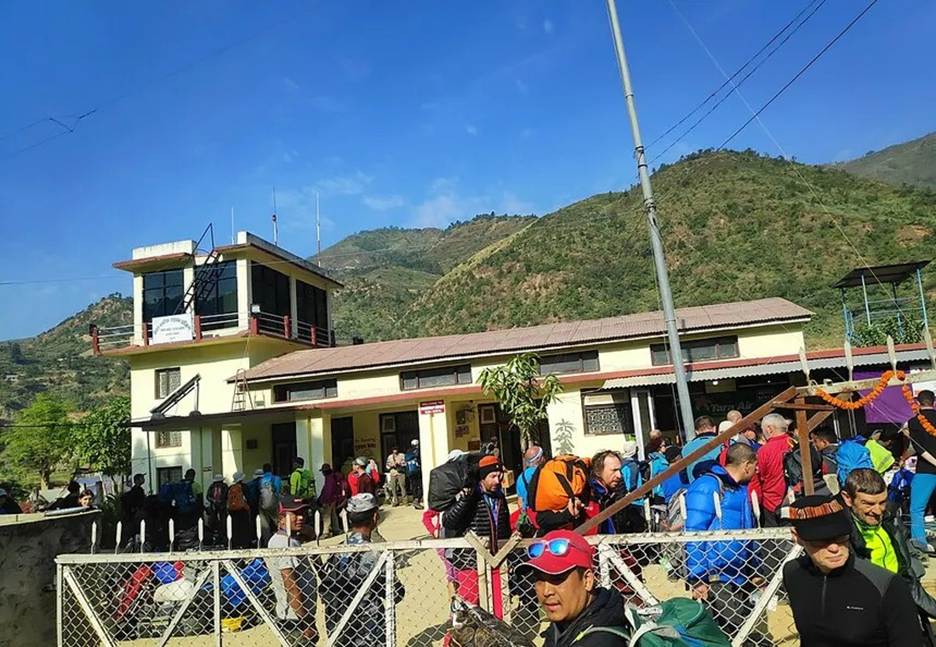
Why ATC cannot “Just Allow One More Flight”
Passengers are always curious to know why their plane has not been able to take off despite seeing that there are no planes in front of it to take off first. The critical aspect that cannot be seen is other planes approaching the airspace and other factors in relation to other airspaces, as well as other weather conditions that are beyond the airport. Allowing “just one more flight” without proper spacing can compromise safety. Aviation is unforgiving, small mistakes can have big consequences. ATCs job is to prevent those mistakes before they happen. Every passenger must know Aircraft is safer on the ground than in air.
Understanding and Managing Passenger Expectations
Passengers can minimize frustration by keeping some buffer days in travel plans during peak times, choosing early morning flights to mountain areas, and staying informed on airline developments, weather updates and so on. The knowledge of conditions that result in unavoidable flight delays during these times can aid in coping with such overcrowded situations. Remember, a delayed flight is inconvenient, but an unsafe flight is unacceptable.
A Message from the Control Tower
Air traffic controllers operate tirelessly in the background, particularly during peak season when there is pressure to perform. Every delay that occurs has only one aim: ensuring that all travelers stay safe. Delays may seem like a hassle; however, they indicate that safety always comes first in the aviation world. So, next time your flight is delayed during peak season, know that it is not due to negligence or indifference. It is the result of careful planning, constant monitoring and a strong commitment to safety, because in aviation, reaching late is always better than taking risks.
Safe travels and thank you for your patience.
This articles is written as guest post by

Sanjay Shrestha
Senior Officer (ATC)
Civil Aviation Authority of Nepal
Kathmandu, Nepal
Email: stha.sanjay24@gmail.com